
The Roti Prata Boss: How to Navigate a Difficult Manager Without Losing Yourself


I once worked under a director who, in all honesty, made me dread coming to work. Not because the work was hard — I've always been someone who takes pride in what I produce. But because no matter how thoroughly I prepared, how carefully I checked, how many rounds of review I did before walking into the room — it rarely felt like it was going to be enough.
This post isn't about him. It's about what that season taught me, and what I'd say to anyone going through something similar right now.
Meet the Roti Prata Boss
If you're Singaporean, you already know what roti prata means in this context. The dough gets flipped — again, and again, and again. What was agreed yesterday is questioned today. The format that was fine last week is now a problem. The position taken in the meeting is, somehow, no longer the position once it appears in writing.
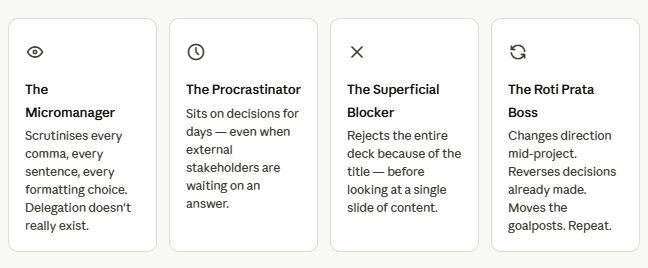
The Roti Prata Boss isn't always one single type. They usually show up as a combination:
What it actually looked like
Let me share some of what I experienced — because I think seeing the specifics is more useful than generalities.
The definition that kept moving
On one memo, I was told the definition should sit in the footnote. I updated it. On the next memo, the feedback came back that it should be in the main body — not the footnote. Similar nature, similar definition. No acknowledgement that the instruction had changed. Just a new comment, delivered with full confidence.
The title that ended the meeting
I had prepared a full deck. Solid content, properly structured, formatting checked. He glanced at the title slide, didn't like what he saw, and asked to close the document. The rest of the slides were never reviewed. We were told to reconvene another day. The work didn't fail — the title did.
The position that disappeared
We aligned on a position in the meeting — he agreed, we all left on the same page. When the supplementary paper was subsequently circulated in writing, a comment came back questioning why that position had been adopted and whether it had been properly thought through. The very same position he had agreed to, now treated as if it had come from nowhere.
The last straw
He requested data from external stakeholders — data we had no clear mandate to ask for — and gave them no lead time. The request went out within the day. Stakeholders were unhappy, not just with the ask, but with how it was done. I was the one left managing the upset stakeholders, explaining our position, trying to preserve relationships I hadn't damaged — for a decision I hadn't made.
The hardest part wasn't the work. It was doing the work carefully, thoroughly, to the best of my ability — and still not knowing if it would clear the room.
How I handled it
I'm not going to dress this up as a neat system, because it wasn't one. What I did was train myself to pause before reacting. Before any conversation with him, I would ask myself: have I genuinely thought this through? Can I defend my position clearly? Have I considered his likely objections and worked through them honestly?
Not because I owed him perfect answers every time. But because I refused to give him easy reasons to dismiss what I was bringing to the table. I made my work harder to poke holes in. I sought clearance from my reporting officer after key meetings so that what was agreed was captured and confirmed — not just floating in memory. I rationalised my point of view critically before I walked in, so I could hold my ground without it becoming a confrontation.
Was it exhausting? Yes. Did it always work? No. But it kept me professional, and it kept my integrity intact.
Knowing when to go
Eventually, I left. And I want to be clear — that was the right decision, not a defeat.
In my new role, I work with bosses who disagree with me, challenge my thinking, and push back on my ideas — and then walk away from the table treating me like an adult who is genuinely trying to do right by the organisation. Decisions made in meetings stay made. There is room for honest, direct, sometimes uncomfortable conversation — and underneath all of it, a fundamental respect and trust that we are all here to do the right thing.
That is not a small thing. And having experienced the alternative, I don't take it for granted.
If you're in it right now
A few things I'd offer, not as a checklist, but as honest reflection:
Get alignment in writing before you build anything.
Summarise what was agreed at the end of every meeting, out loud, in the room.
Loop in your reporting officer so decisions don't live only in one person's memory. Build relationships beyond your direct boss — your credibility and your stakeholder goodwill cannot be entirely dependent on one bottleneck.
And be honest with yourself about whether you are growing here, or just surviving.
Staying in a difficult dynamic is sometimes the right call. But make it a conscious choice — not a default.

Comments